
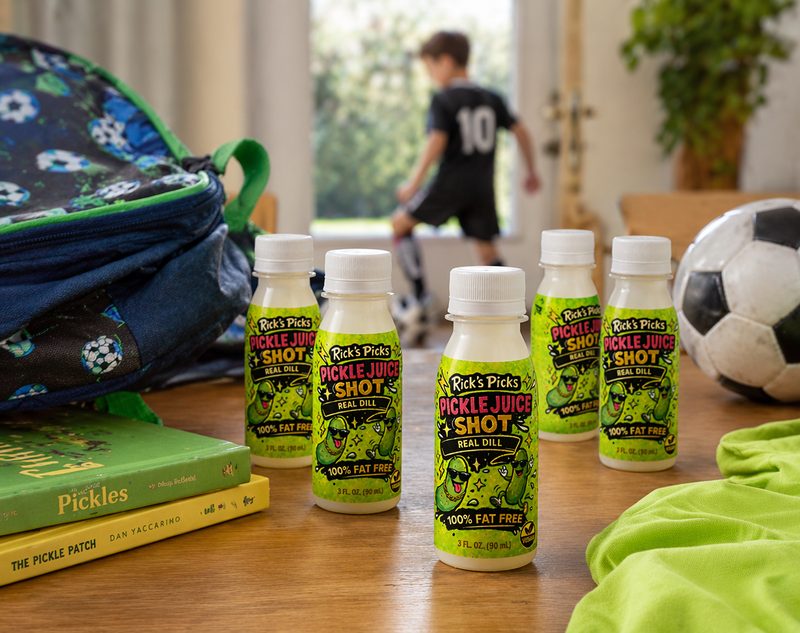
Pickle brine spent most of its life as the liquid you pour down the sink. In 2026 it is a shelf-stable product sitting next to the checkout at major grocers, and the category is growing faster than most things in beverages.
Nothing about the ingredient changed. What changed was everything around it. That makes pickle juice a useful case for anyone thinking about where new products actually come from, because the answer is often not where people look first.
The habit came before the market
Trainers in professional American football were giving brine to cramping players in the 1990s. There was no product, no brand, and no research. It was leftover liquid from a jar that seemed to help, and it moved through locker rooms by word of mouth into running, cycling, and tennis.
That is worth noting on its own. The behaviour existed for roughly twenty years before anyone tried to sell it. Consumers were already doing the thing. Nobody had packaged it.
The research made it credible
A study published in Medicine & Science in Sports & Exercise looked at electrically induced cramps in dehydrated subjects. Those given a small volume of pickle juice recovered in about 85 seconds, considerably faster than those given water. Later work has reported relief somewhere in the 35 to 90 second range.
The interesting part was the mechanism. Researchers measured blood sodium and plasma volume and found no meaningful change during the window when the cramps stopped. A small volume of brine takes around thirty minutes to leave the stomach, so at 85 seconds it had not been absorbed. Electrolyte replacement could not account for it.
The leading explanation places the effect in the throat rather than the muscle. Acetic acid, the sharp component of vinegar, stimulates sensory receptors in the mouth and pharynx, which appears to trigger a reflex that reduces the nerve activity sustaining the cramp. Researchers refer to this as an oropharyngeal reflex.
Because the mechanism depends on contact rather than digestion, the volume needed is small. Published research points to roughly 1 mL per kilogram of body weight, or two to three ounces for most adults.
The science is still developing, and brine is not a replacement for proper hydration. But the research did something commercially significant: it turned an unusual habit into a defensible reason to buy. That is often the step that moves a behaviour from niche to category.
Then taste and market conditions aligned
Consumer appetite for sour, salty, and fermented flavours has grown considerably, and pickle has moved into popcorn, protein bars, seltzer, and confectionery. Industry commentators have described it as the leading trending flavour profile of the year.
The market data reflects it. The broader pickle category was valued at approximately $26.6 billion in 2025, tracking toward $28.2 billion in 2026. Pickle juice as a standalone drinks category was worth about $0.92 billion in 2025 and is projected to reach $2.01 billion by 2034, growing at 9.1 percent annually. Analysts attribute the growth to three things: demand for functional beverages, sports nutrition expanding well beyond competitive athletes, and continued momentum behind clean-label formulation.
Three separate trends converged on one ingredient. None of them was about pickles specifically.
The format was the innovation
Here is the part most relevant to product development.
Brine has existed for centuries. It was never inaccessible. But it only came as the liquid left in a jar, which meant you could not carry it, portion it, chill it separately, or buy it without buying pickles first.
A single-serve shot resolves all of that. It is portioned, portable, and usable across occasions that a jar cannot serve, from a gym bag to a job site to a bar.
The ingredient did not need to be reinvented. The delivery format did.
This pattern recurs across food and beverage. Cold brew was coffee. Protein shakes were milk and whey. Yoghurt tubes were yoghurt. In each case the commercial breakthrough came from matching an existing ingredient to how people now live, rather than from creating something genuinely new.
What this means in practice
For anyone assessing a new product idea, the pickle juice example suggests a few questions worth asking early.
Is there an existing behaviour? Consumers drinking brine straight from the jar was a stronger signal than any concept test, because it was unprompted and had persisted for decades.
Is there a reason beyond novelty? Flavour trends fade. A functional claim with research behind it gives a product something to stand on once the novelty passes.
Is the barrier the ingredient or the format? If people already want it and simply cannot get it conveniently, the development problem is narrower and the route to market is shorter.
Does the market data support duration? A category growing at 9 percent a year over a decade is a different proposition from a flavour spiking on social media for a season.
Where Marcatus QED fits
We work with food brands on exactly this stage, taking a concept and turning it into something that can be produced consistently and at volume. In 2026 we completed a project of this kind: a long-standing customer approached us with an idea for a pickle juice shot, and we worked with them through development to a finished product now on the market.
Most of what a customer needs at that point is not a new idea. It is help testing whether the idea holds, then solving the formulation, format, packaging, labelling, and production questions that stand between a concept and a shelf.
The brine had been sitting in the jar the whole time. The work was in recognising it was worth selling on its own, and then building it properly.