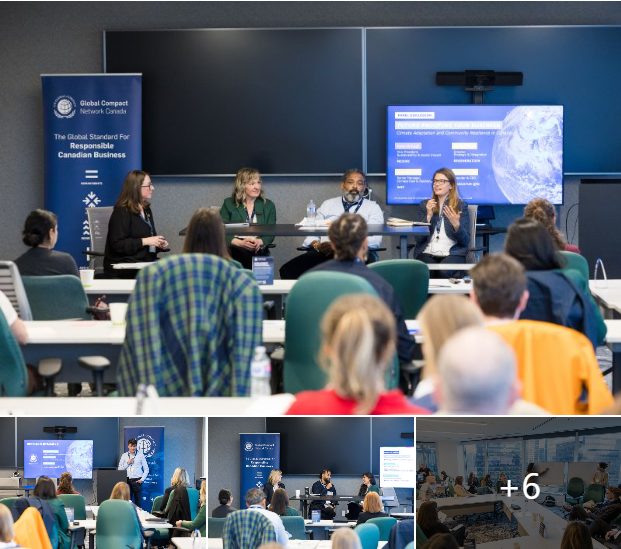
Marcatus QED CEO and founder Murali Sundar took part in a panel on community-centered climate adaptation, hosted in Vancouver by UN Global Compact Network Canada, of which Marcatus QED has been a member for many years.
The hybrid event, “The Business Case for Community-Centered Climate Adaptation,” was presented in partnership with West Fraser Timber and funded through Natural Resources Canada’s Climate Change Adaptation Program. It brought business leaders from across the country together around a set of questions that are getting harder to avoid: how community partnerships strengthen climate resilience, what genuine collaboration looks like once you move past consultation, and how businesses can assess climate and social risk together rather than separately.
Murali was invited to represent agriculture and food, and to bring the sector’s practical realities into the discussion.
“Climate adaptation is not only about business risk or environmental planning,” he said. “It is about people, communities, and long-term resilience. Real progress happens when we take the time to listen, build trust, and work with communities, rather than creating solutions from the outside.”
Much of the day focused on co-creation, on the limits of traditional business metrics for measuring this kind of work, and on building partnerships that reflect what local communities actually prioritise.
Marcatus QED drew on two current examples. The first is our hydroponic container farm in Prince Edward County, which addresses food security through year-round local growing. The second is our recent collaboration with the University of Guelph and Indigenous communities in Northern Ontario. Both point in the same direction: the solutions that hold up are practical, local, and built with the people they affect.
Murali also noted the value of hearing how other industries are approaching the same problem, including West Fraser, the world’s leading wood products company.
“Much like agriculture, meaningful impact does not happen overnight,” he said. “It takes patience, shared purpose, and respect for local realities. That is how real impact is created, season by season, year by year, by working together for the next generation.”
Our thanks to UN Global Compact Network Canada, West Fraser, and everyone who helped bring the conversation together.